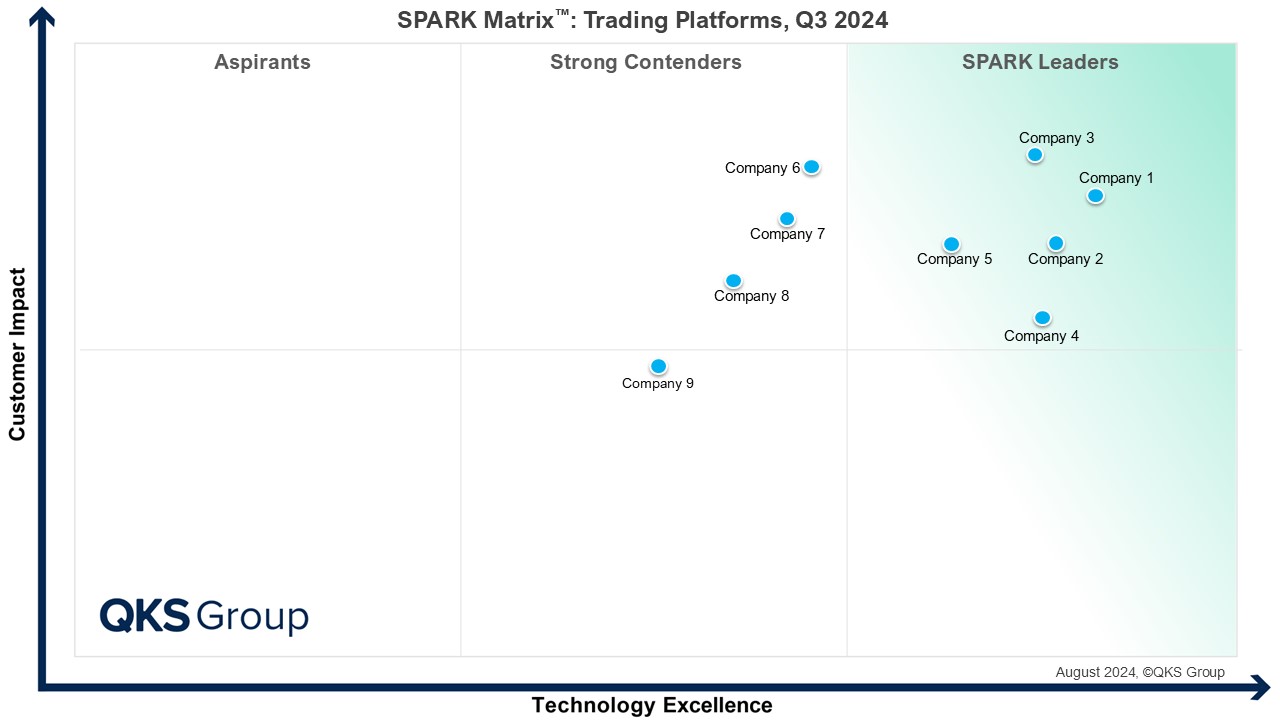
In today’s fast-moving financial markets, the role of Trading Platforms has expanded far beyond the basic execution of buy-and-sell orders. These digital systems have become the backbone of global investment activity, enabling traders and institutions to access multiple asset classes, analyze market data in real time, and execute strategies with precision and speed. As trading grows increasingly data-driven and automated, Trading Platforms are evolving into intelligent, connected ecosystems that support analytics, risk management, compliance, and portfolio monitoring—all within a unified interface.
Click Here For More Information: https://qksgroup.com/market-research/spark-matrix-trading-platforms-q3-2024-8024
Understanding the Core Purpose of Trading Platforms
A Trading Platform is a software solution provided by financial institutions, brokers, or fintech providers that allows investors and traders to access various markets—equities, derivatives, commodities, forex, crypto, and more. At its foundation, it processes market data, offers real-time quotes, and enables users to place orders either directly or via brokers.
What makes modern platforms indispensable is their capability to handle the entire trade lifecycle: execution, risk assessment, clearing, settlement, and reporting. As markets become more complex and integrated, organizations increasingly rely on advanced trading systems to manage capital markets operations efficiently and securely.
Key Features and Functional Capabilities
1. Real-Time Market Data and Advanced Analytics
Financial decisions depend on timely and accurate data. Trading Platforms aggregate live feeds from global exchanges, providing:
- Real-time pricing and charts
- Market depth and liquidity views
- Technical indicators and algorithmic signals
- Predictive analytics powered by AI and machine learning
These insights enable users to make informed decisions and detect opportunities before competitors.
2. Multi-Asset and Cross-Market Access
Today’s traders expect seamless access to diverse investment options. Advanced platforms support:
- Stocks, ETFs, bonds
- Futures, options, and derivatives
- Forex and commodities
- Digital assets like cryptocurrencies
Multi-asset capabilities allow investors to diversify portfolios and implement multi-market strategies from one interface.
3. Order Execution, Routing, and Management
The core of every Trading Platform lies in its execution engine. Modern tools optimize order handling via:
- Smart Order Routing (SOR)
- High-speed trade execution
- Automated trading algorithms
- Risk checks before and during execution
This leads to minimal slippage, reduced latency, and improved overall trading performance.
4. Risk Assessment and Compliance Monitoring
Regulatory oversight and financial risk continue to intensify in global markets. A strong Trading Platform ensures:
- Real-time risk scoring
- Margin checks and exposure monitoring
- Automated compliance alerts
- Audit trails for every trade
By integrating compliance into the workflow, organizations avoid violations and reduce financial penalties.
5. Clearing, Settlement, and Accounting Integration
A trade doesn’t end with execution. Platforms automate back-office operations such as:
- Clearing and settlement workflows
- Transaction logging
- Journal entries to accounting systems
- Integration with financial reporting tools
This end-to-end automation reduces manual errors and accelerates reconciliation.
6. Post-Trade Analytics and Reporting
Post-trade insights help investors refine their strategies. Platforms deliver:
- Performance dashboards
- Cost analysis
- Trade attribution reports
- Benchmark comparison
Combined with AI, these insights help traders optimize execution and adjust strategies for future trades.
Download Sample Report Here: https://qksgroup.com/download-sample-form/%20?id=8024
Why Trading Platforms Are Becoming More Critical
The modern financial world demands agility, accuracy, and transparency. This is why organizations—from hedge funds to brokerage houses—are rapidly modernizing their digital trading infrastructure.
Key drivers include:
- Growing trading volumes across asset classes
- Real-time decision-making requirements
- Rising algorithmic and automated trading adoption
- Increasing regulatory scrutiny
- Demand for digital, cloud-based investment platforms
Additionally, the shift toward SaaS-based and API-driven platforms empowers organizations to scale efficiently, manage costs, and support global operations.
The Role of Emerging Technologies
AI, machine learning, cloud computing, and blockchain are transforming today’s Trading Platforms:
- AI-driven algorithms help detect anomalies, generate signals, and enhance forecasting accuracy.
- Cloud-based platforms offer scalability, resilience, and lower infrastructure costs.
- Blockchain is improving transparency in clearing and settlement.
- APIs and microservices improve connectivity with fintech apps, custodians, and market data vendors.
This blend of innovation is redefining speed, security, and user experience.
Enterprise and Institutional Use Cases
Large enterprises use Trading Platforms to support:
- Proprietary trading desks
- Treasury operations
- Hedging and risk mitigation
- Portfolio and wealth management
- Regulatory reporting
By integrating trading systems with risk, finance, and analytics tools, institutions gain a centralized view of financial operations, which improves decision-making and operational efficiency.
Become A Client: https://qksgroup.com/become-client
Conclusion
As financial markets advance toward hyper-digitization, Trading Platforms are becoming the central nervous system of modern trading environments. They integrate real-time data, advanced analytics, automated execution, compliance tools, and post-trade intelligence—empowering organizations to trade smarter, faster, and safer. With AI, cloud technology, and global connectivity accelerating change, the next generation of Trading Platforms will redefine the boundaries of market innovation, offering unmatched insights and operational resilience for traders worldwide.