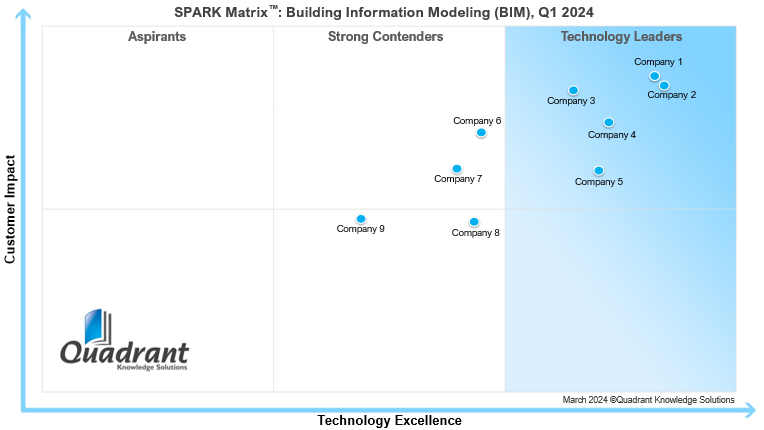
In today’s rapidly evolving construction industry, digital transformation is no longer an option—it’s a necessity. At the forefront of this revolution is Building Information Modeling (BIM), an advanced technology that seamlessly combines cloud computing, data management, and visualization tools to transform how buildings and infrastructure are designed, constructed, and managed.
According to Quadrant Knowledge Solutions, BIM has emerged as a pivotal enabler for smart construction, integrating both geometric and non-geometric data into a unified digital model. This approach enhances every phase of a project’s lifecycle—from planning and design to operation and maintenance—driving efficiency, collaboration, and innovation.
Click Here For More Information: https://qksgroup.com/market-research/spark-matrix-building-information-modeling-q1-2024-3107
What is Building Information Modeling (BIM)?
At its core, BIM is a digital representation of the physical and functional characteristics of a facility. It goes beyond simple 3D modeling to create a shared information platform that allows architects, engineers, contractors, and owners to collaborate in real time.
Unlike traditional 2D drawings, BIM creates intelligent, data-rich models that include precise details about materials, dimensions, costs, timelines, and even sustainability parameters. By combining geometry (3D visualization) with non-graphical data (metadata and documentation), BIM helps project teams make informed decisions throughout the entire project lifecycle.
Streamlining the Construction Lifecycle
One of BIM’s greatest strengths lies in its ability to streamline every stage of a construction project:
- Planning and Design:
BIM tools enable architects and engineers to visualize complex structures in 3D before ground is even broken. Early design simulations help identify potential issues, such as spatial conflicts or design inefficiencies, reducing costly rework later.
- Construction and Sequencing:
Using 4D BIM (time-based modeling), project managers can simulate construction sequences and visualize project timelines. This helps in identifying bottlenecks, coordinating trades, and optimizing workflows—resulting in faster, safer, and more predictable project delivery.
- Operation and Maintenance:
Once construction is complete, BIM continues to add value through facility management. The digital model serves as a “living document,” containing comprehensive information about equipment, systems, and maintenance schedules. This allows facility owners to manage assets more efficiently over the building’s entire lifespan.
Download Sample Report Here: https://qksgroup.com/download-sample-form/%20?id=3107
Leveraging Cloud, Data, and Visualization Technologies
BIM’s evolution has been fueled by the convergence of several cutting-edge technologies:
- Cloud Computing:
Cloud-based BIM platforms, such as Autodesk BIM 360 and Bentley’s ProjectWise, enable real-time collaboration across geographies. Teams can access and update models simultaneously, ensuring everyone works with the latest project data. - Data Management:
Construction generates vast amounts of data. BIM systems integrate with data analytics and IoT sensors to provide actionable insights—from material usage to energy efficiency—enhancing decision-making and sustainability. - Advanced Visualization:
The integration of Virtual Reality (VR), Augmented Reality (AR), and Mixed Reality (MR) in BIM enables immersive project visualization. Stakeholders can virtually “walk through” a design before construction, improving understanding, stakeholder engagement, and design approval processes.
The Power of Clash Detection and Coordination
One of the most valuable capabilities of BIM lies in clash detection—identifying conflicts between architectural, structural, and MEP (Mechanical, Electrical, Plumbing) systems before construction begins.
For instance, a pipe running through a structural beam can be flagged instantly during the design phase, saving both time and money that would otherwise be spent on rework. This proactive approach to coordination and risk mitigation significantly enhances project quality and reduces delays.
Enhancing Collaboration and Communication
Traditional construction projects often suffer from fragmented communication, where information silos and disconnected teams lead to inefficiencies and errors. BIM bridges this gap by providing a centralized digital environment where all stakeholders—architects, engineers, contractors, and owners—can collaborate seamlessly.
This shared ecosystem improves transparency, accountability, and coordination, ensuring that everyone has access to consistent and up-to-date information. As a result, BIM not only enhances teamwork but also helps build trust among project participants.
Driving Sustainability and Smart Construction
In an era where sustainability and environmental responsibility are paramount, BIM plays a crucial role in enabling green building practices.
By integrating energy analysis, material optimization, and carbon tracking, BIM empowers design teams to evaluate environmental impacts early in the process. The result is reduced waste, optimized resource usage, and buildings designed for long-term energy efficiency.
Moreover, when combined with IoT sensors, BIM models can evolve into digital twins—virtual replicas of physical assets that continuously gather and analyze operational data. This connection enables predictive maintenance, energy monitoring, and enhanced lifecycle management, further improving sustainability outcomes.
BIM as a Catalyst for Digital Transformation in Civil Engineering
The construction and civil engineering industries have historically been slow to digitize, often relying on manual methods and paper-based workflows. BIM is now changing that narrative by acting as a catalyst for digital transformation.
It bridges the gap between design intent and field execution, integrates data across disciplines, and leverages automation to reduce errors and improve accuracy. As the technology matures, BIM is increasingly being integrated with AI, machine learning, and generative design, allowing systems to propose optimal design alternatives based on performance goals and constraints.
This convergence of technologies is leading toward the era of smart construction ecosystems, where buildings are not only designed intelligently but also built and operated with precision and foresight.
The Future of BIM: From 3D to 7D Modeling
The future of BIM goes far beyond 3D visualization. Today, we are witnessing the evolution of multi-dimensional BIM, encompassing:
- 4D (Time) – Project scheduling and sequencing
- 5D (Cost) – Budget management and cost forecasting
- 6D (Sustainability) – Energy and environmental analysis
- 7D (Facility Management) – Lifecycle and asset maintenance
These extended dimensions make BIM an indispensable tool for holistic construction management, enabling a deeper understanding of project performance, cost implications, and long-term operations.
Conclusion
Building Information Modeling (BIM) is more than just a technology—it’s a transformative methodology reshaping the future of construction and civil engineering.
By integrating cloud computing, data analytics, and visualization tools, BIM empowers stakeholders to plan, design, construct, and manage infrastructure with unprecedented accuracy and efficiency.
In essence, BIM represents the digital heartbeat of modern construction, driving collaboration, sustainability, and innovation across the built environment—paving the way toward a smarter, more connected future.